The Antiochian House of Studies is pleased to announce the forthcoming Master of Eastern Orthodox Canon Law, a distinctive fully online graduate program created to meet the growing need for serious, scholarly, and pastorally responsible study of the canonical tradition of the Eastern Orthodox Church.
Designed for students throughout the United States, Canada, and beyond, this graduate program offers advanced academic formation for clergy, lay leaders, educators, researchers, and others seeking a deeper understanding of Eastern Orthodox canon law and its application in the life of the Church.
A Unique Program for Our Time
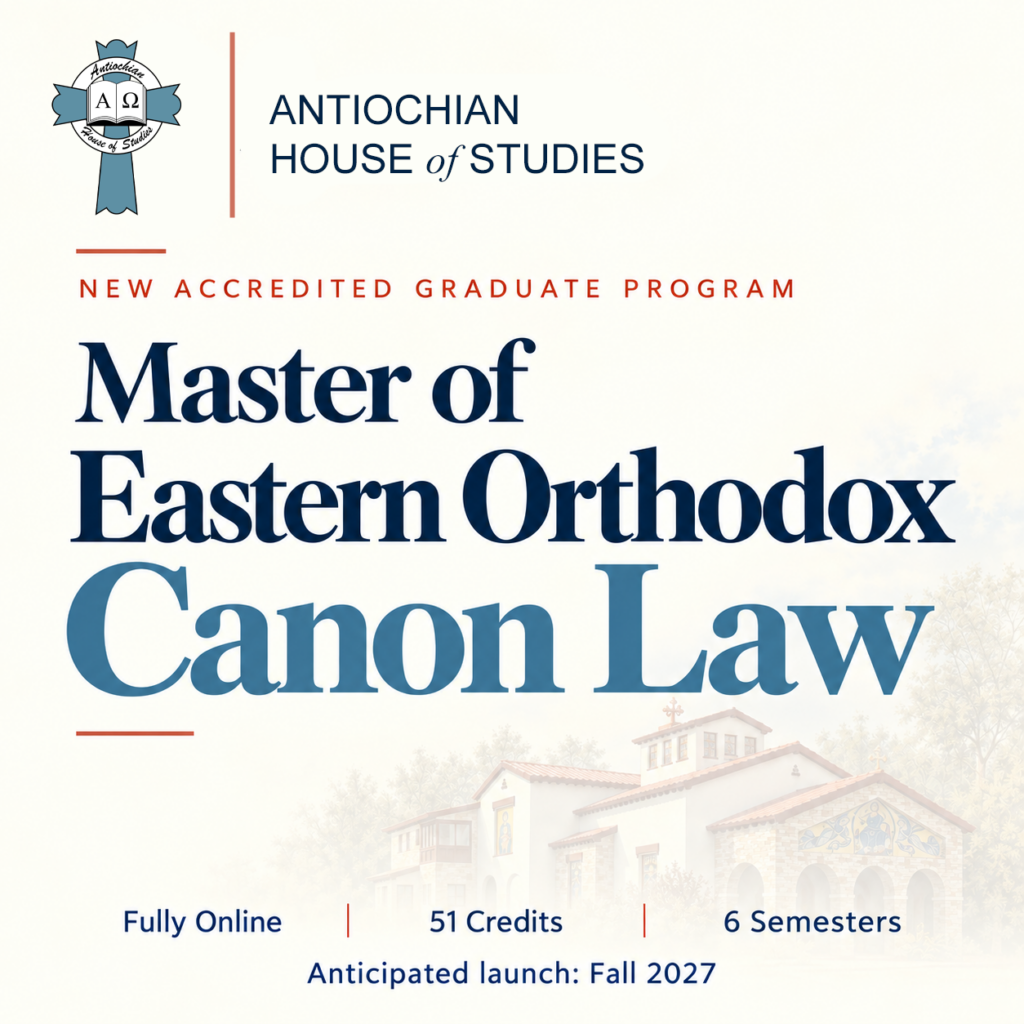
The Master of Eastern Orthodox Canon Law is a 51-credit graduate degree that includes 39 core credits, 6 elective credits, and a 6-credit thesis.
The curriculum brings together theological depth, historical study, pastoral awareness, Canonical Greek, research methodology, and original scholarly research in a coherent six-semester course of study.
At a time when the Church faces important questions involving marriage and family, Church administration, sacramental practice, clergy and monastic life, ecclesiastical discipline, reception into the Church, and relationships among Orthodox jurisdictions, this program offers students the knowledge and tools needed to engage these matters faithfully and responsibly.
Why This Program?
- Fully online and accessible: Study through a structured online format that includes faculty-guided instruction, synchronous sessions where scheduled, recorded lectures, guided discussions, close reading, research, and individualized feedback.
- Accredited academic setting: The program is being developed and submitted within the academic and accreditation framework of the Antiochian House of Studies, serving national and international.
- A distinctive curriculum: Courses address the theological foundations of canon law, Church governance, marriage and family, clergy and monasticism, the Holy Mysteries, Church–State relations, spiritual courts, discipline, and contemporary canonical questions.
- Direct access to sources: Students develop competence in Canonical Greek and learn to read and interpret primary canonical texts from early, Byzantine, and modern Orthodox traditions.
- Serious research and scholarship: The degree culminates in a six-credit master’s thesis, enabling students to produce original, supervised research in Eastern Orthodox canon law.
Distinguished Curriculum
Students in the program study the theological foundations of Eastern Orthodox canon law, the formal corpus of the holy canons, Church organization and governance, marriage and family, clergy and monasticism, the Holy Mysteries, spiritual courts and disciplinary procedures, Church-state relations, comparative canon law, and contemporary canonical questions.
The curriculum also includes Canonical Greek I and II, reading proficiency in primary canonical texts, and a master’s thesis based on original graduate research.
Timely and Needed
The Orthodox Church in North America lives in a diverse, pan-Orthodox environment. Questions concerning Church order, marriage and family, sacramental practice, reception into the Church, governance, discipline, and relationships among jurisdictions require informed, faithful, and pastorally responsible engagement with the canonical tradition.
This program comes at an important moment: it prepares graduates to study, teach, research, interpret, and responsibly support the canonical life of the Church in response to contemporary ecclesial questions and challenges.
Learn From Qualified Experts
The program is developed and taught by qualified faculty with advanced academic preparation and demonstrated competence in Orthodox canon law, theology, Church history, patristics, ecclesiology, Canonical Greek, and related disciplines.
Students receive close academic guidance, meaningful faculty interaction, research support, and thesis supervision from professors committed to rigorous scholarship and service to the Church.
Thesis supervision is provided by scholars with doctoral or comparable qualifications relevant to each student’s research area.
Students benefit from academic mentoring, substantive faculty interaction, disciplined research formation, and a curriculum shaped through faculty leadership, ecclesial consultation, and ongoing academic review.
Fully Online and Academically Rigorous
The program is delivered entirely online through structured learning that includes faculty-guided instruction, synchronous meetings when scheduled, structured asynchronous learning activities, scholarly reading, research, discussion, writing, and individualized feedback.
The degree is being offered through the Antiochian House of Studies within its established academic and accreditation framework, and the proposal indicates an anticipated implementation date of Fall 2027.
Program Highlights
- 51 graduate credits: 39 core credits, 6 elective credits, and a 6-credit thesis.
- Six-semester structured curriculum.
- Courses in Canonical Greek I and II and Reading Proficiency in Primary Canonical Texts.
- Specialized study of marriage, family, clergy, laity, monasticism, sacramental discipline, Church administration, ecclesiastical courts, and Church–State relations.
- Electives in contemporary canonical issues, parish life in North America, reception of heretics and schismatics, directed readings, and special topics.
- Preparation for scholarship, teaching, Church administration, research, publishing, translation, diocesan support, and further graduate study.
Prepare to Serve the Church
Graduates are prepared for advanced research, teaching, publishing, translation, diocesan and parish support, Church administration, educational ministry, and further graduate study.
Study the holy canons.
Understand the challenges of today.
Serve the Church with knowledge, discernment, and faithfulness.