Saturday, 30 May 2026
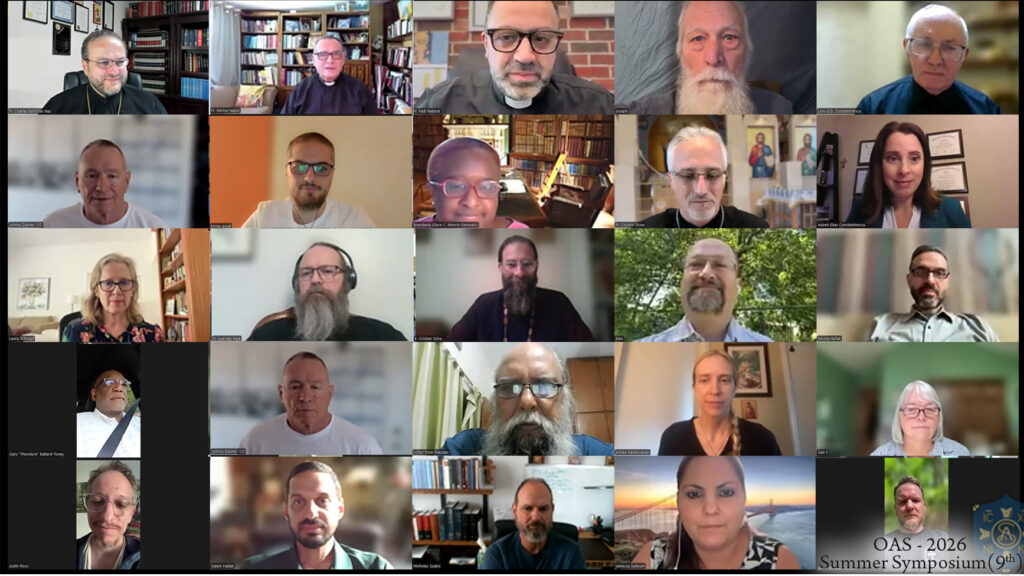
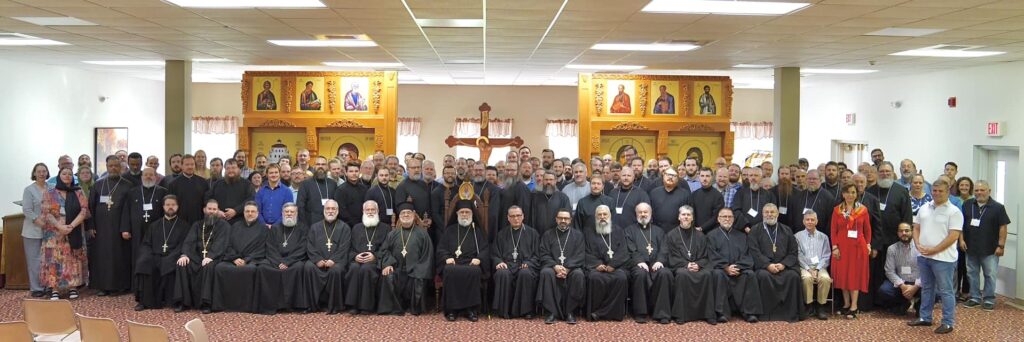
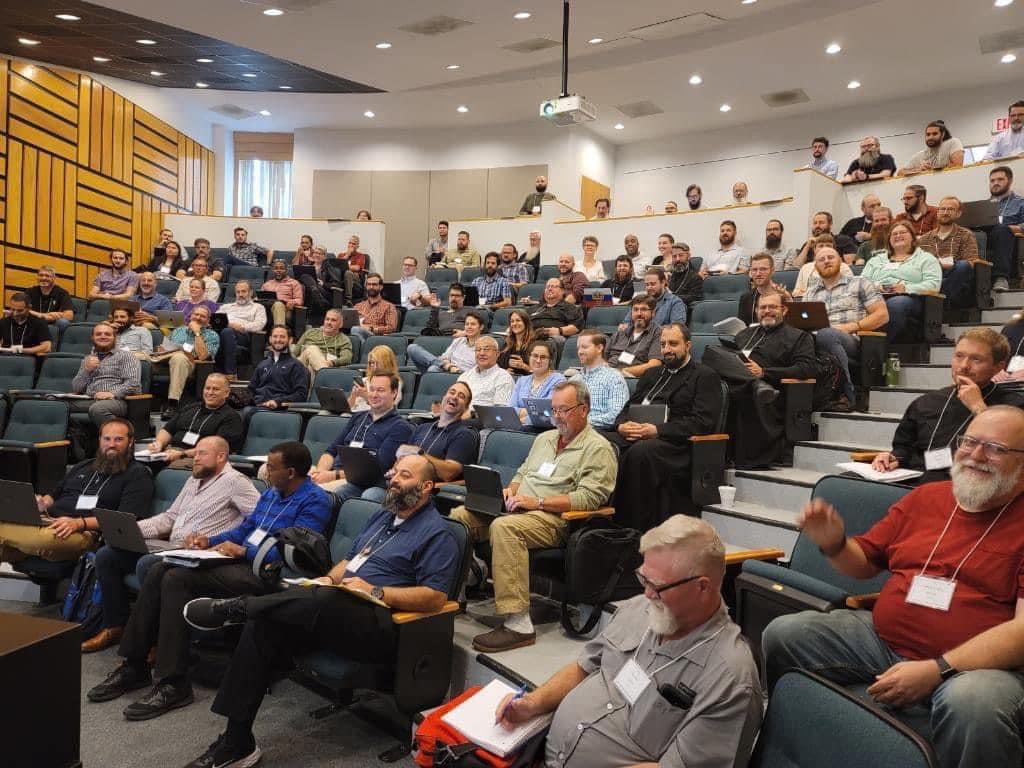
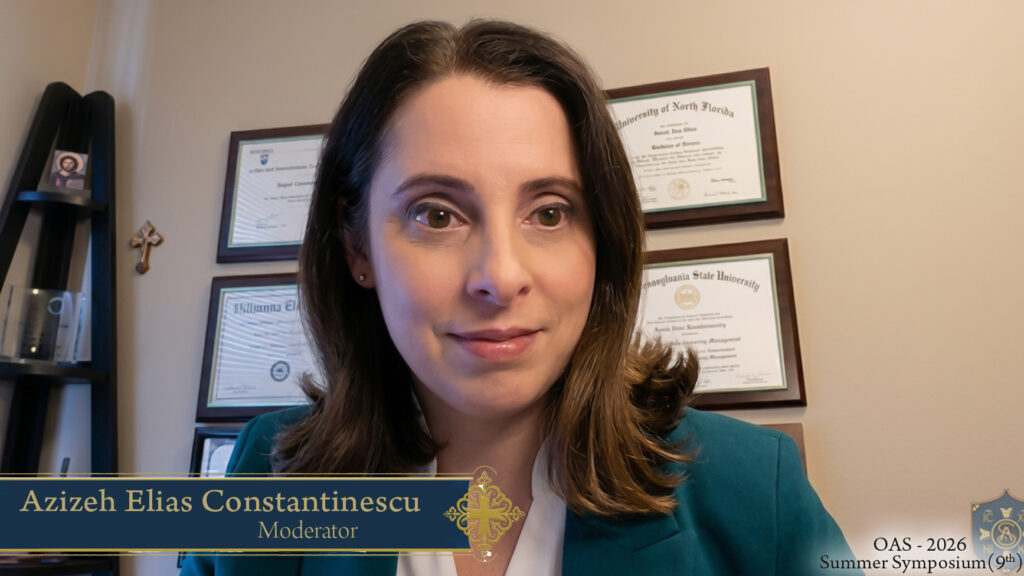
On Saturday, 30 May 2026, the Orthodox Academic Society of the Antiochian House of Studies gathered online for its Ninth Summer Symposium, drawing faculty, students, alumni, and friends of the House into a day of sustained theological reflection. Under the moderation of Mrs. Azizeh Elias Constantinescu, and opening with prayer, the assembly turned its attention to one of the most enduring questions of the Christian intellectual tradition: how faith and reason meet, and part, in the mind of the Fathers.
The theme — Faith and Reason in the Patristic Mind: From Creed to Controversy — framed a day devoted not to abstraction but to the living memory of the Church. Across two opening addresses and four scholarly papers, presenters traced how the Fathers, far from setting reason against revelation, disciplined the mind in the service of truth, and how that same discipline confronted, named, and refuted the heresies of every age.
Opening Remarks
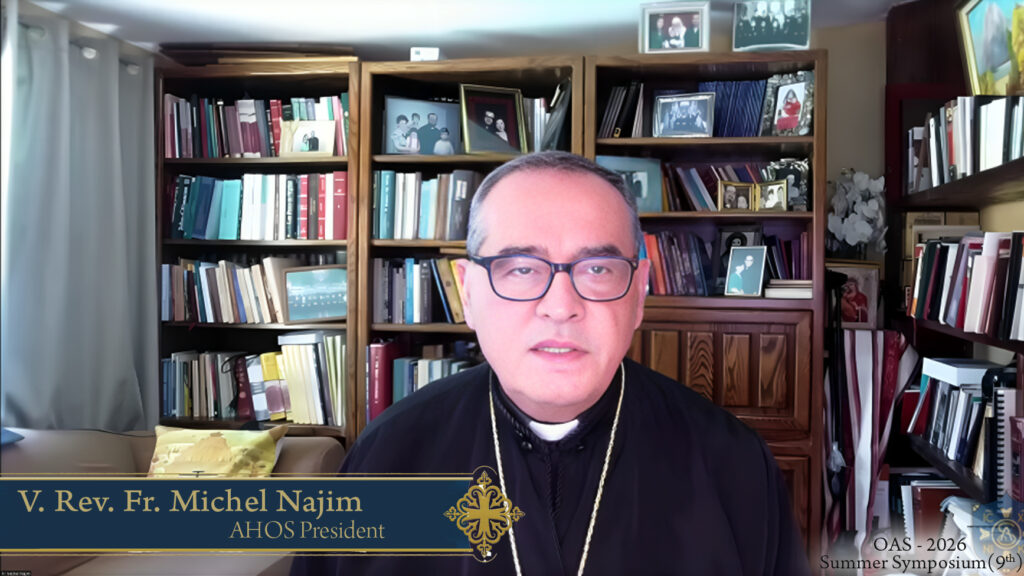
The President: V. Rev. Fr. Michel Najim
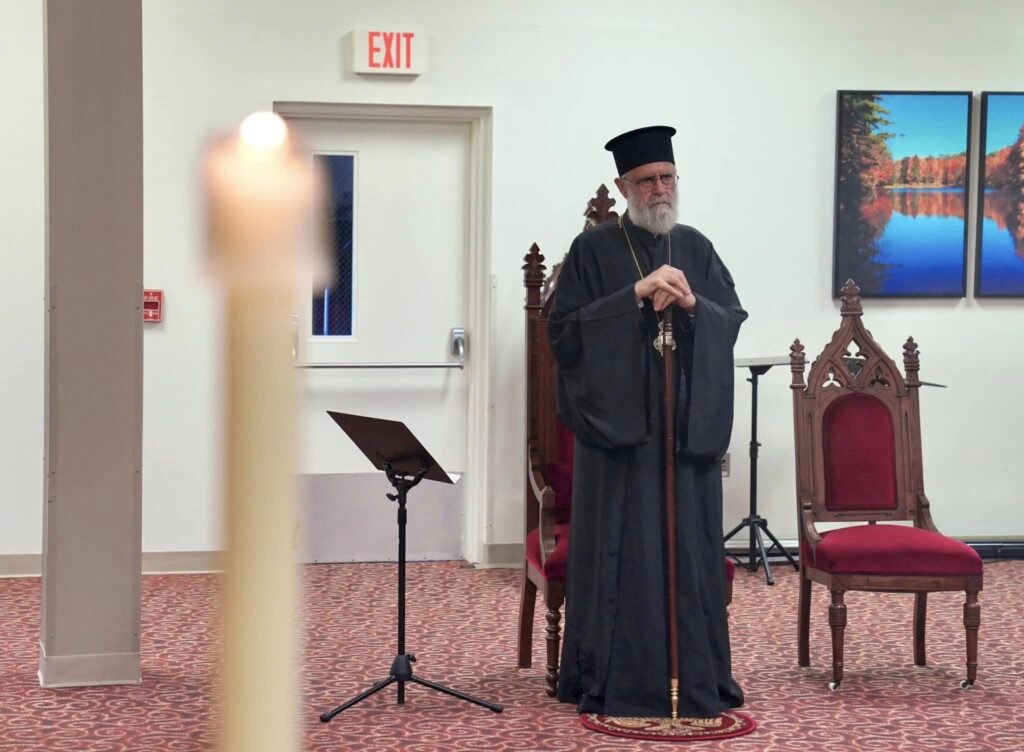
Welcoming participants on behalf of His Eminence Metropolitan Saba, Academic Dean Fr. Fadi Rabbat, and the wider community of the House, the President of the Antiochian House of Studies, V. Rev. Fr. Michel Najim, set the intellectual foundation for the day. He recalled the patristic teaching that every human person possesses both a rational and a noetic faculty — the nous, the “eye of the soul,” being the organ of contemplation and communion with God.
The Fathers, he stressed, never rejected reason. Rather, they taught that reason must be illumined and guided by the purified nous. On this foundation they refuted heresy by every available means: constructive reasoning and apologetics, logic and philosophical terminology, legal argument, and scientific inquiry — while remaining wary of sophistry whenever it threatened to obscure spiritual truth. Fr. Najim moved through a striking gallery of witnesses to this conviction: St. Basil the Great, who brought philosophy and science to the service of a thoroughly biblical reading of creation in the Hexaemeron; Justin Martyr, who employed the instincts of a lawyer to defend Christians before Roman authority by appeal to Lex Romana and due process; St. Justinian, whose Corpus Juris Civilis shaped the legal foundations of Europe; John of Damascus, who systematized the faith and catalogued the heresies in De Fide Orthodoxa; and St. Photios the Great, whose encyclopedic Myriobiblos surveyed fourteen centuries of Greek learning even as he refuted the Filioque from Scripture, tradition, and logic.
The accumulated witness, Fr. Najim argued, demonstrates a single principle: the Fathers employed both the noetic and the logical faculties to teach, to promote true knowledge, and to confront error — and this remains the proper method of doing theology.
Opening Remarks
The Academic Dean: Rt. Rev. Archimandrite Fadi Rabbat
The Academic Dean, Rt. Rev. Archimandrite Fadi Rabbat, welcomed the gathering with a reflection on why such a symposium matters at all. Theology in the Orthodox Church, he reminded participants, can never be reduced to detached analysis: it arises from revelation, matures in worship, is tested in ascetic life, and is entrusted to the Church as a living confession. Gatherings like this one, he said, are therefore more than conferences — they are acts of ecclesial remembrance, occasions on which the Church listens again to the voices that defended her confession in times of turmoil.
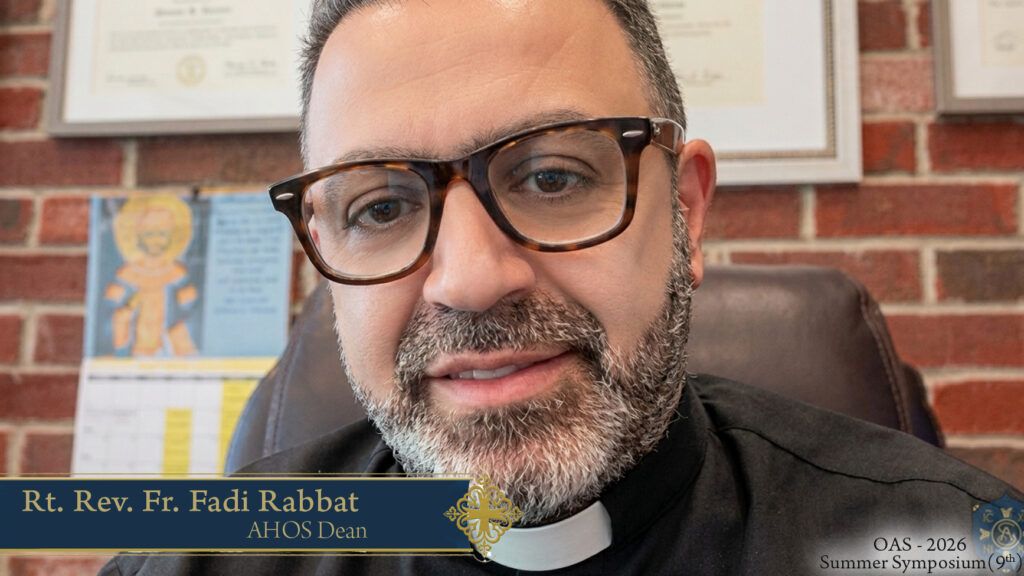
Fr. Rabbat drew out the symposium’s central conviction: faith and reason are not natural enemies. Reason is a God-given faculty that finds its fulfillment when illumined by revelation and purified by grace; severed from humility it grows proud and sterile, but united to prayer and repentance it becomes a servant of truth. The Fathers, he observed, “did not defend orthodoxy by rejecting thought—they defended orthodoxy by disciplining thought.” He pointed to the learned saints — Basil and Gregory the Theologian, formed in the schools of Athens; John Chrysostom, trained in rhetoric under Libanius; and, in a later age, St. Luke of Simferopol, surgeon and bishop — as proof that the Church never feared learning, only the pride that mistakes learning for salvation.
Clarity can be an act of charity, precision a form of pastoral care, and careful theological language a protection for the faithful against confusion.Rt. Rev. Archimandrite Fadi Rabbat
Turning to the subtitle, From Creed to Controversy, the Dean reminded the assembly that Orthodoxy did not take shape in the abstract. The creeds and conciliar definitions were forged in conflict, when the truth of Christ’s person, the Holy Trinity, and the nature of salvation were under attack. The Fathers labored over single words because a single term could protect an entire vision of salvation. He closed by commending the day to the students in particular: to love theology deeply enough to refuse superficiality, and to let academic discipline become an offering to God, so that study leads finally to prayer, wonder, and holiness.
First Paper
Theosis in the Patristic Mind
Fr. Cristian Sylva · AHOS M.Div. Graduate · “Faith, Reason, and Fr. John Romanides’ Neo-Patristic Defense of Orthodoxy”
Fr. Cristian Sylva opened the scholarly sessions with a study of theosis — deification — as the core of Orthodox theology and the ultimate goal of human existence: real union with God, grounded in the Gospel as participation in the divine life. Tracing the doctrine from Athanasius’ classic affirmation that “God became man so that man might become god” through Maximus the Confessor and Gregory Palamas, he presented theosis not as metaphor but as a genuine ontological transformation by grace.
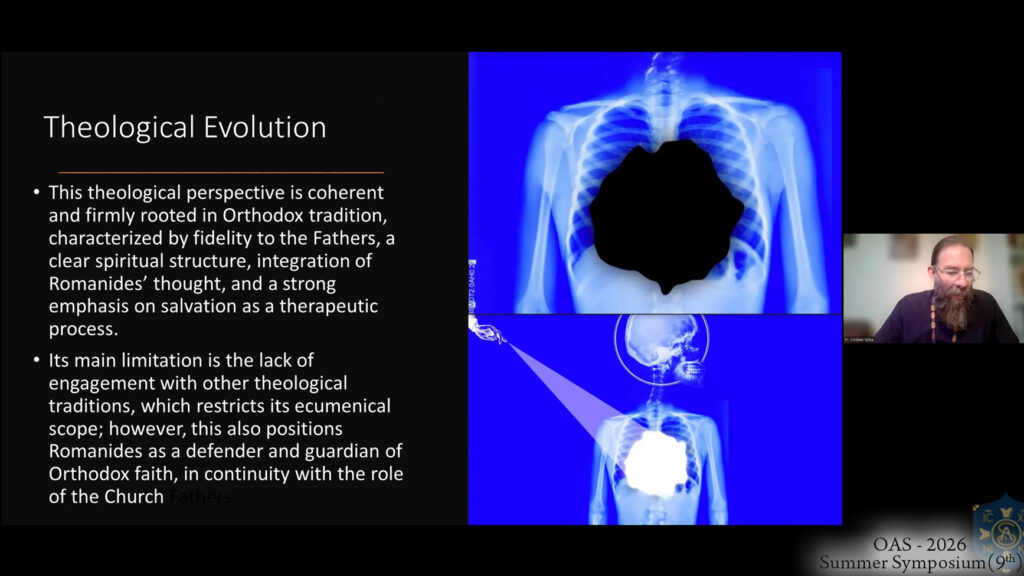
The heart of the paper was its reading of Fr. John (Ioannis) Romanides, who reframed Orthodox theology as an empirical and therapeutic science. On this account, theology is verified not through speculation but through the lived path of purification, illumination of the nous, and deification. Sin is understood less as a juridical fault than as a spiritual illness — a darkening of the nous — and salvation as its healing. Fr. Sylva traced Romanides’ image of the Church as a hospital, the priest as physician acting through Christ, and the sacraments as therapeutic means whose efficacy depends on the believer’s disposition.
Crucially, the paper insisted that authentic theology arises from the direct experience of God rather than from logic alone — the authority of the Fathers resting on their participation in deification, not on intellectual mastery. Fr. Sylva also weighed Romanides’ sharp critique of Western scholasticism, which he charged with severing theology from spiritual experience, while noting candidly that this same posture limits its ecumenical reach even as it casts Romanides as a guardian of the Orthodox faith in continuity with the Fathers. Far from a rupture with the tradition, he concluded, Romanides offers a faithful reinterpretation of it: theology is life, not theory; theosis is the goal, the nous the means of communion, and the Fathers the path.
Second Paper
Being Clothed and in Our Right Minds
Fr. Juvenaly Hale · AHOS M.Div. Graduate · “The Edenic Garment in St. Ephraim the Syrian and St. Theophan the Recluse”
Fr. Juvenaly Hale offered a meditation on the “garment” of Eden, reading St. Ephraim the Syrian and St. Theophan the Recluse together across the span of many centuries. The governing movement of the paper was a single arc — robed, then naked, then robed again — tracing humanity’s original clothing in light, its loss through the fall, and its restoration in Christ.
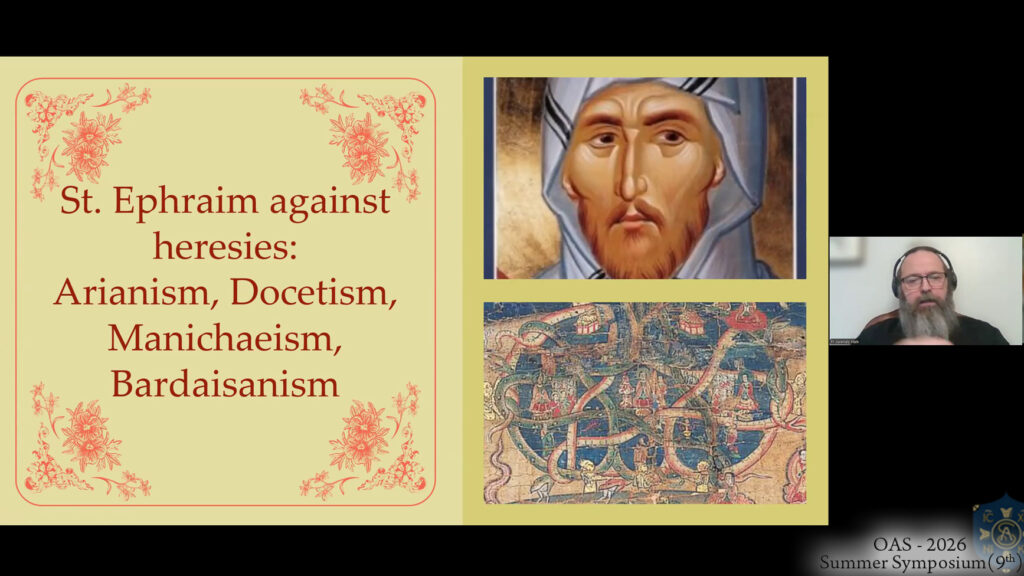
Drawing on St. Ephraim’s hymns against the heresies of his day — Arianism, Docetism, Manichaeism, and Bardaisanism — Fr. Hale showed how the imagery of nakedness and the “first robe” carries a precise theological confession: that Christ is eternally God, omnipotent, truly incarnate, and that the human person may be renewed to the original garment of glory. He set beside Ephraim the later witness of St. Theophan, who confronted rationalism, heterodoxy, and secularism, and who taught that the fallen condition is not natural to humanity at all.
Third Paper
Natural Revelation in St. Basil’s Hexaemeron
Fr. Cosmin Sicoe · Ph.D. Student, AHOS
Fr. Cosmin Sicoe took up the ancient question — “What has Athens to do with Jerusalem?” — and answered it through the Orthodox doctrine of natural revelation, read in the light of St. Basil the Great’s nine fourth-century homilies on creation. Setting Tertullian’s famous challenge alongside the modern restatement of the “conflict” of science and faith, he argued, with St. Dumitru Staniloae and St. Maximus the Confessor, that the Orthodox Church makes no separation between natural and supernatural revelation: the two laws, natural and written, are of equal dignity and reveal the same Word.
The paper’s center was a close reading of the Hexaemeron itself. From its opening insistence on the “good order” of visible things, Fr. Sicoe showed how St. Basil reads the cosmos as a school in which reasonable souls learn to know God — the mind led “as by a hand” from the visible to the invisible. He gathered Basil’s lessons drawn from creation: the moral instruction of the bees, storks, and swallows; the praise that the very deeps render to their Creator; and the summons to rise from the beauty of creatures to the Creator Himself, and so to turn away from sin.
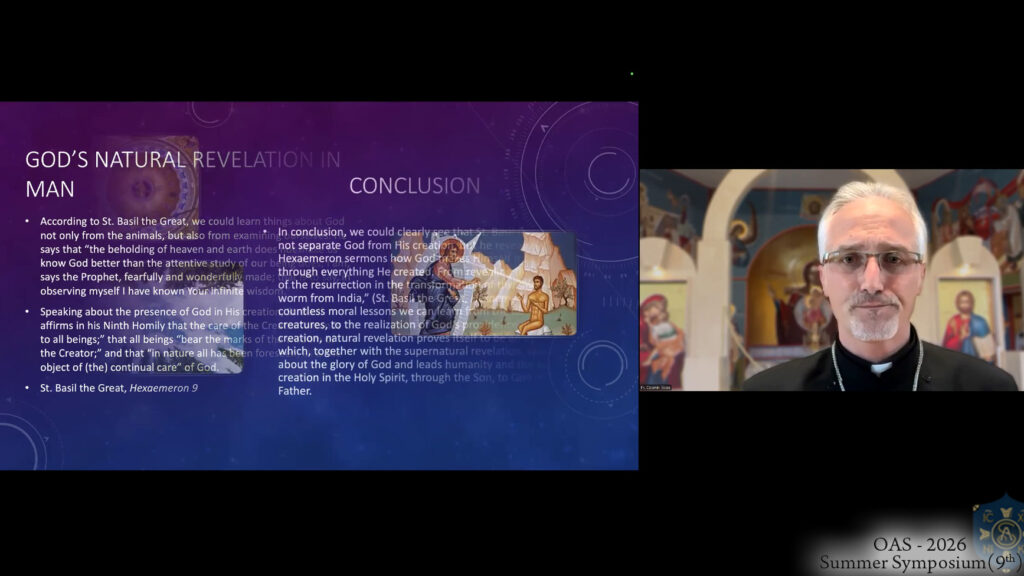
Fr. Sicoe situated Basil within a wider Orthodox witness to natural revelation, drawing on St. Maximus the Confessor on the harmony of the natural and written laws, St. Symeon of Thessalonica on the very mind of man as proof of God to the unbeliever, and the modern theology of St. Dumitru Staniloae and Fr. Georges Florovsky on the rationality of the cosmos and the logoi of the Logos. Christ, he affirmed with these witnesses, is the ultimate revelation of God, the One through whom all things were made; and the visible world becomes the means of a loving dialogue between the divine Person and human persons.
Reason, for the discovery of truth, is much surer than the eye.St. Basil the Great, Hexaemeron VI
Natural revelation, Fr. Sicoe concluded, is an open book which, together with supernatural revelation, proclaims the glory of God and leads creation, in the Spirit and through the Son, to the Father.
Fourth Paper
Education as Emancipation
Fr. Charles Nicholas Baz · Ph.D. Student and Faculty · “Orthodox Pedagogy as a Catalyst for Resilience under 18th-Century Ottoman Rule”
The symposium’s final presentation addressed the sensitive yet pivotal 18th century which impacted the entire Orthodox Church in all the world. Fr. Charles Nicholas Baz examined the condition of the Orthodox Church under Turkokratia, when Christian populations lived as “conquered nations” of subordinate Dhimmi status, governed through the Roum Millet system that made the Ecumenical Patriarch both shepherd and civil Ethnarch. He charted the fragmentations of the era — the suppression of Slavic autocephaly, the Melkite schism of 1724, the dominance of the Phanariots over the ancient Eastern patriarchates, and the parallel subjection of the Russian Church under Peter’s Holy Governing Synod — alongside an educational crisis that drove the ambitious westward and let Latinizing and rationalist currents into Orthodox thought.
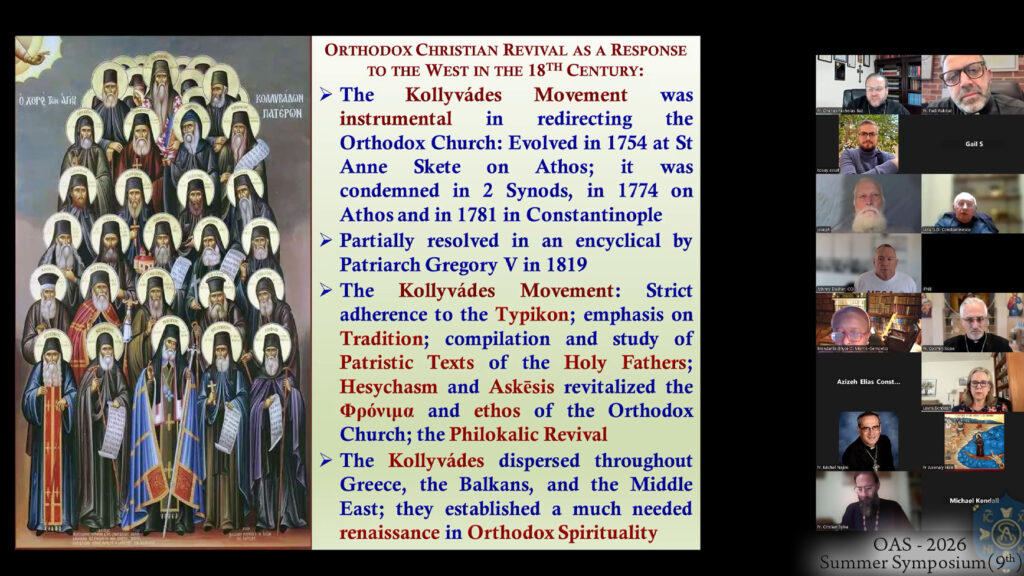
Against this background, Fr. Baz presented the monasteries, and above all the Kollyvades movement born on Mount Athos in 1754, as the “last bastion” of undefiled Orthodoxy — a Philokalic revival aimed at restoring the phronema, the mindset, of the Church. He drew out three towering figures of renewal: the Holy Hieromartyr Kosmas Aitolos, the “Preacher of the Nation,” who walked the Balkans founding schools and was martyred in 1779; St. Makarios Notaras of Corinth, architect of the Neo-Patristic synthesis and compiler, with St. Nikodemos the Hagiorite, of The Philokalia; and Nikephoros Theotokis, the Corfiot polymath who united the sciences with the defense of the faith.
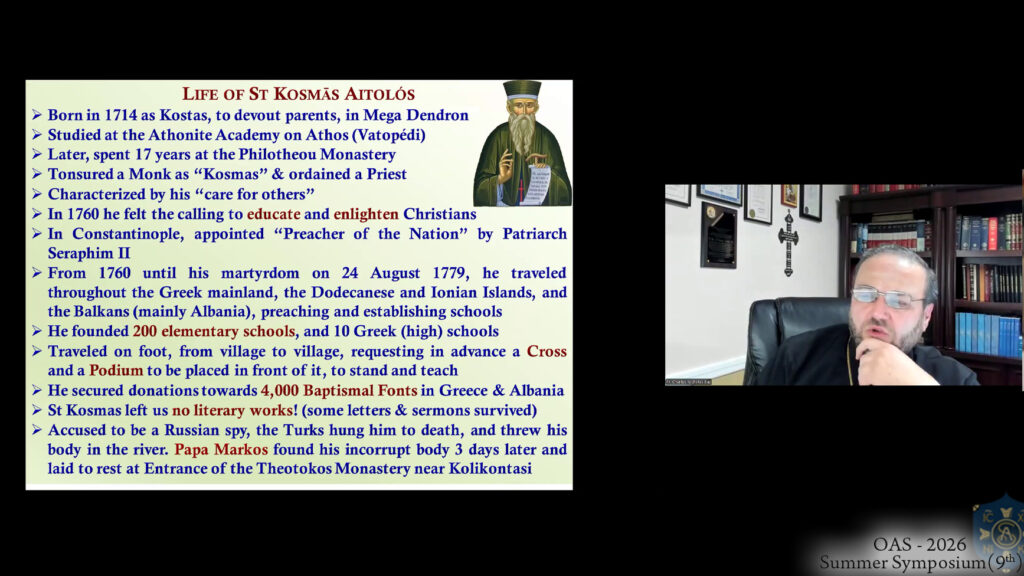
Fr. Baz drew these figures vividly: Kosmas demanding that a cross and a podium be raised in every village he visited, credited with some two hundred elementary schools and the provision of thousands of baptismal fonts for impoverished regions; the partnership of Makarios as compiler and fundraiser with Nikodemos as editor and publisher, yielding not only The Philokalia but works on frequent communion and the Evergetinos, a “medical guide of the soul”; and Theotokis the scholar of physics and mathematics whose path led from a school in Corfu to the hierarchy of the Russian Empire. Education, Fr. Baz concluded, became a genuine form of emancipation: by resisting both assimilation and secularizing rationalism, these movements preserved a distinct Orthodox identity and handed the faithful the tools of resilience needed to endure.
In Closing
A Day of Shared Inquiry
Between and after the papers, the symposium gave ample room to conversation. Presenters fielded questions from faculty, students, and alumni; lines of inquiry opened by one speaker were taken up and tested by another; and the exchange ranged freely across the day’s themes — the relation of the nous to discursive reason, the therapeutic reading of salvation, the reach of natural revelation, and the lessons of Orthodox resilience under pressure. The discussion was marked throughout by the very spirit the speakers had commended: rigorous yet reverent, precise yet pastoral, an exchange of ideas conducted as an act of the Church rather than a contest of opinions. In this dialogue the symposium showed itself to be not a series of isolated lectures but a single, shared conversation, in which each contribution illumined the others.
Having begun in prayer, the gathering fittingly ended in prayer. The Society offered its closing supplication together, commending the day’s labor — every word spoken, heard, and considered — to God, and sealing the work of the mind in the worship of the heart. So the Ninth Summer Symposium drew to its close as it had begun: within the life of the Church, and for her glory.
From creed to controversy, the Ninth Summer Symposium returned the Society not to dead texts but to living witnesses — voices that still illumine the Church because they spoke from within her life.